
The Monster in the Maze – Kiri Te Kanawa Theatre: September 20, 2025 (13th Floor Theatre Review)
MONSTER IN THE MAZE “re-imagines” in modern opera the legend of Theseus, the Minotaur, and the annual slaughter of Athenian youth to that monster. It evokes therein the tragedy of refugees forced afloat on the Mediterannean, of hostages imprisoned, of youth slaughtered in war and famine, and (perhaps) of unnamed hazards felt by youth from digital to environmental to questions of identity. It’s an opera, but it feels more like oratorio, an incredibly affecting one.
What’s the story? Crete’s King Minos has conquered Athens and announces his plan: Athens will send their best youth each year to be devoured by his bestial stepson, the Minotaur, in the labyrinth in which he has imprisoned it. This is the monster in the maze.
But this is the tale told without the usual supporting structure. And it’s only an hour—but it only needs that hour to create tension, catharsis, and release. So the tight focus clearly works. But it means there’s no Icarus, no Ariadne, no string, no wax, no wings—and the maze-creator Daedalus appears like a wraith from nowhere to guide our heroes through the maze, only to disappear from relevance before the end.
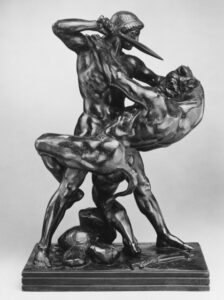
So we’re in a maze (a Matrix?). How to get out if it!? It’s a question metaphorically confronting every young person in an increasingly complex world. But there’s no answers here, just lament. Until, enter stage left: Theseus—who vows to sail with the young hostages and kill the savage beast.
Bizarrely, the only real plot conflict here is with his mother. “Don’t go,” she cries. “I must” he says. And off he sails into legend. The opera that starts with lamentation ends with hosannas.
It’s rare to end a tragic opera with heroes triumphant and without bodies strewn across the stage. It’s just as rare to have a modern opera enjoyed so much by audience and participants.
For the participants are many. It’s all about community participation: anyone who wanted to register, attend the rehearsals and perform in the production, could. The music then is primarily choral—Cretans and Athenians both presented, appropriately, as a Greek chorus—and the choral writing for these singers is wonderful. Not all singers are trained—these are folk many of whom have never been on stage before, or never even sung before! Which suits the piece completely: voices old and young, trained and untrained, high and low (the high creating especially effective fear) harmonise loosely and hauntingly.
This choral singing is the core of the piece. It makes for static drama, but it suits the trajectory of the music.
A highlight for me was the demand by the Cretan chorus to “Take Them to the Labyrinth” —tremendously effective, in music, in staging, and in choreography (by Petmal Petelo).
The music itself is evocative, achieving its aim by simple means. Percussive chimes, descending harmonies. It feels as primeval as the legend, as subterranean as the labyrinth itself. For that, much credit to composer Jonathan Dove and librettist Alasdair Middleton.
On this powerfully painted palette, the soloists themselves (there are just three) struggle to compete. They seem conventional, poorly drawn and with little of anything to say.
Ipu Laga’aia’s Theseus is the best of the three. His boyish exuberance compels, his young slightly wavering tenor suits the role. Sarah Castle’s Mother struggles with different volume in different registers—odd, since she’s sung in Bayreuth in roles demanding volume!—but she comes in mightily at the finale. Joel Amosa does as well with Deadalus as he’s allowed to, which isn’t a lot, sadly, since his voice demands more.
The best “vocalist” however is Maaka Pohatu’s Minos, a speaking role undertaken with volume, with heart, and with a booming voice that fills the theatre. (If I were a young Athenian, I’d be scared!)
The music itself is delivered by the Auckland Philharmonia as persuasively, this time under the baton of Brent Stewart.
The whole one-hour production (directed by Anapela Polata’ivao, Tinā, Red White and Brass, Wild Dogs Under My Skirt) is said to “reimagine the legend of Theseus and the Minotaur through an Aotearoa lens.” I’m not sure that aim was entirely successful, but all credit to this cast and crew and production team for the bold choice of opera, the broad choral cast, and the tale it tries to tell.
Bravo!
THEATRE PETER.
[Production photos by Emma Brittenden]
THEATRE PETER.
Click here for Wellington and Christchurch tickets
