
Nuremberg Dir: James Vanderbilt (13th Floor Film Review)
Nuremberg: A thought provoking, exploration of one of history’s most divisive moments.
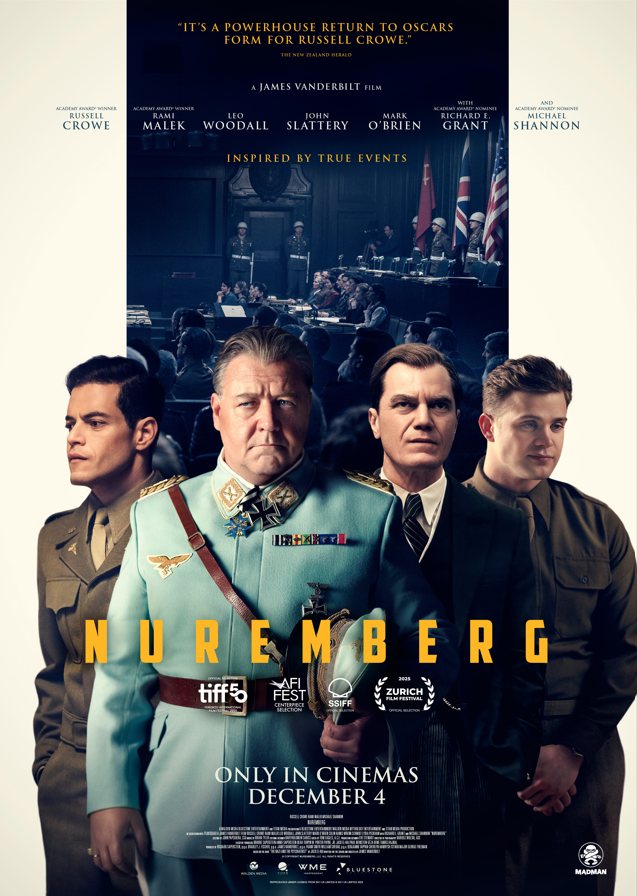
Starring Russell Crowe, Rami Malek, Michael Shannon, Richard E. Grant, Colin Hanks, Leo Woodall
1945 and Hitler has lost the war in Europe and with the Germans surrender the world now has to deal with a new issue: what to do with all the Germans that were part of the Third Reich’s command structure and those that helped bring Hitler to power? The major Allied powers decided to put key German leaders on trial in the hope of documenting their atrocities and, through delivering justice, dissuade future war crimes. And they decided to hold those trials amongst the rubble of Nuremberg.
Just that set up alone is a delicious premise for a film and Nuremberg approach’s the story through the eyes of Douglas Kelley, the young, somewhat naive psychiatrist, tasked with determining whether the senior Nazi’s were sane and fit to stand trial. Including Adolf Hitler’s second in command Hermann Göring played by Crowe.
A chilling, mesmerizing performance by Russell Crowe puts humanity into one of history’s worst monsters. A timely reminder that even though someone might be vile and cruel, they often also have the power to be charming and disarming. Hard to imagine anyone pulling this off as well as Crowe. In a moment he can shift from playful and mischievous to a look that gives chills and you believe that this is a man that can send millions to their death and not lose a minute of sleep.
Rami Malek (Kelley), while excellent, never feels the equal to Crowe in presence or control. If you were hoping for an intellectual joust, the likes of Hopkins and Foster in Silence of the Lambs, you may feel a little let down by some script moments that don’t quite land.
Kiwi star, Lydia Peckham is a phenomenal femme fatale but woefully underused here. Expect she’ll be collecting a gold statue herself in a few years time. Prediction, locked in!
Outside of some mixed performances, the film also starts with some peculiar pacing issues, and clumsy tonal shifts (there were some funny one liners and even some scene transitions that got laughs, but not sure they fit here). However, the film drops a black and white bomb on the audience at the halfway mark that leaves you feeling too raw for any more jokes.
And it’s in the third act that Nuremberg finds it’s feet despite a number of ‘movie moments / character monologues’ that nearly pulled me out of its trance. You get treated to a courtroom drama segment that feels like it could nearly give ‘A Few Good Men’ a run for its money with a few more tweaks (“You can’t handle the truth” would actually be a fitting tagline for this film).
Director James Vanderbilt and Crowe decided to film those courtroom scenes like a play, utilizing extended takes (over 20 minutes long) which absolutely transitions intensity to the screen and captures raw, uninterrupted performances (earning multiple standing ovations from the crew).
Above it all though, what Nuremberg has going for it, which makes all its minor flaws forgivable, is that this is a fascinating moment in history, and a story that could spark a multi-hour conversation with whoever you watch this with (not recommended as Date Movie though!). Have to note though, it doesn’t have the gravity, maturity or nuance of 1961’s Judgement at Nuremberg (which rightly won 3 Oscars including best screenplay), so make sure y’all see that as well, once you’ve checked this out at the cinema.
Matthew Rice
Nuremberg is in cinemas now
