
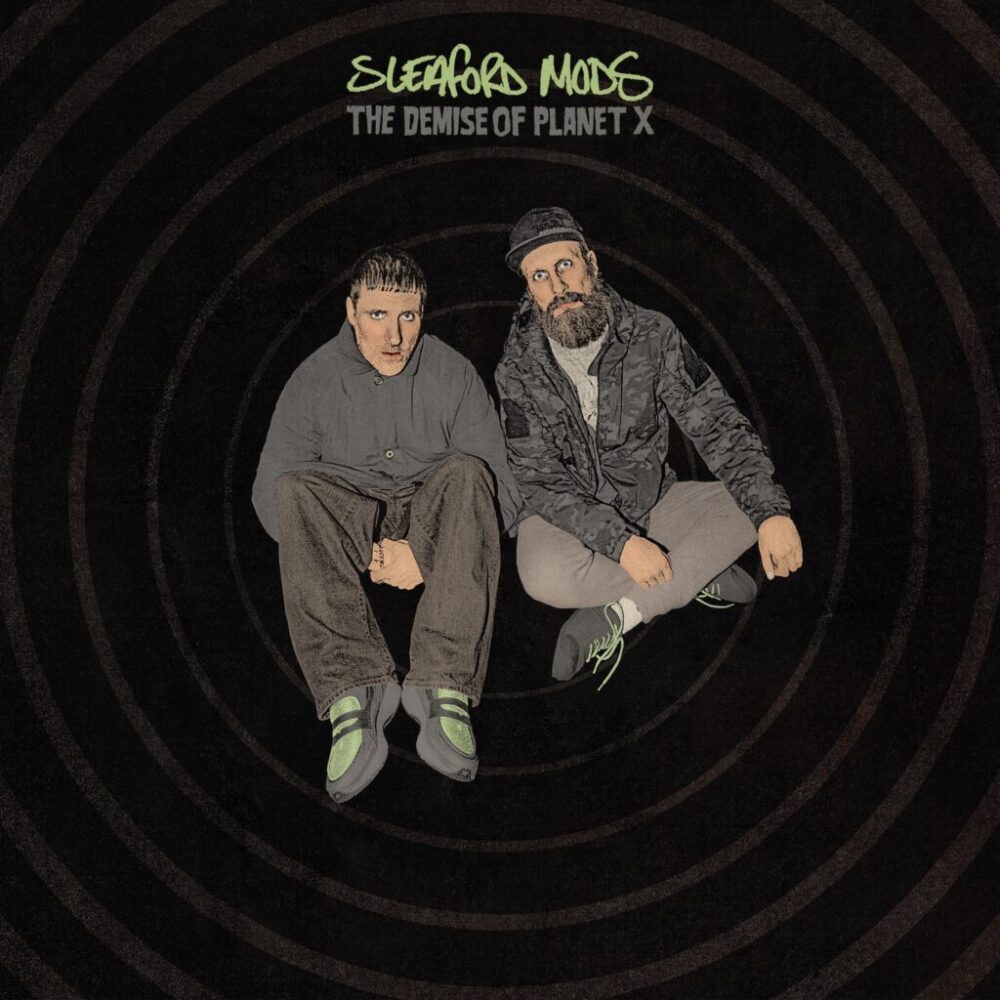
Sleaford Mods — The Demise of Planet X (Rough Trade) (13th Floor Album Review)
There’s a particular eccentric electricity that East Midland’s Sleaford Mods generate-the feeling that someone has kicked open a door to modern working class reality and is narrating the mess from a position close to, but not right in, the action.
The Demise of Planet X is lean, unsentimental, and a tad more varied than they’ve previously allowed themselves to be, an album that looks at the world, shrugs at the emerging apocalypse , and instead catalogues the day to day shittiness with their standard grim wit and danceable dread.

The setup is stark, landing two years after UK Grim and extends their social x‑ray from national rot to planetary demise. Pre-release singles have been a breadcrumb trail—Megaton, The Good Life, Bad Santa, No Touch—each hinting at collaborators and a broader palette. The Mods have collaborated before notably with the likes of The Prodigy and Leftfield. Here the guests here aren’t window dressing to create popular appeal but stress fractures in the Mods’ brickwork that shed an unusual edgy light.
Singer and lyricist, James Williamson has been plain about the headspace it’s a record shaped by “immense uncertainty, mass trauma,” and a desire to resist via sound as much as stance. That frame matters because it explains both the clenched-jaw energy and the album’s surprising openness to other voices.
Andrew Fearn’s beats still feel classically inexpensive-dry snares, sour synths, bass that thumps like a pub table—but the edges blur aa bit more than earlier work. You can hear additional studio heft (JT Soar, Abbey Road, Invada) without any loss of bite- the mix keeps Williamson right in your face, syllables landing like coins dropped on a pub pool table.
The Good Life is the album’s opening and its best provocation. If you’ve seen Ben Wheatley’s single-take video it amplifies the chaos, but on record the interplay comes to the fore. Gwendoline Christie arrives like Williamson’s interior prosecutor, and Big Special’s chorus hauls the song toward something almost uplifting something glimpsed, not grasped. It’s Christie’s first foray into recorded music and she sounds ferocious, a theatrical presence cut to fit Fearn’s tight frame.
Double Diamond is classic Mods minimalism, a stalking bassline and a lyric that skewers performative self-importance—social media peacocking rendered as petty tyranny. It’s a sly evolution rather than a makeover; the Mods move by increments, and the increments add up.
Elitest G.O.A.T. hands New Zealand’s own Aldous Harding the spectral role—cool air against Williamson’s heat. The contrast adds melody without blunting attack, it’s the kind of move the Mods may not have explored a decade ago.
No Touch brings Sue Tompkins’ brittle, conversational vocal; recorded in a quick, two‑day burst, even her head‑cold rasp was kept in because it served the track’s nervy mood. Those choices—keep the imperfection, prioritise the take—are why the album feels like reportage, not a careful curation.
Elsewhere, Liam Bailey and Snowy widen the sonic field on Flood the Zone and Kill List, nudging the duo toward their grime roots and soul shades without losing the Mods’ deadpan stomp. The result is variety in color from the same palette.
Williamson’s writing remains a spiky ledger of grifts, mediocrity, and frayed masculinity. The insults are surreal enough to be funny and precise enough to deliver their messages. There’s also a bit of self-audit, an artist interrogating his own appetite for slagging off peers, recognising the damage, then turning that recognition into material.
“Planet X” counts the minutes of mundanity and finds menace still lurking there. Clocking around 41 minutes across 13 tracks, the album moves with club-set efficiency- little fat, lots of impact. If you expected a degree of revolution-by-arrangement, you’ll find none as the point is discipline, repetition, and language as percussion. What is new is the way guest spots tilt the mood between cuts, turning the record into a single room with different shadows providing emphasis.
Somehow heading close to twenty years of making their specific form of artistic social commentary, Sleaford Mods don’t reinvent themselves here so much as recalibrate: same engine, some varied revs. The Demise of Planet X is an interesting development not because it’s in anyway soft but because it admits other timbres to help shape their message. The result is a set that feels angry, amused, and aware. Existing fans should embrace the changes and for new listeners a comparatively gentle introduction before exploring the back catalogue.
I missed their sold out shows when they toured in 23 and later when I told my North England mates, they had been here they were right pissed that I hadn’t told them they were coming, “they’re the real voice of working class Britain mate!”. Based on the latest LP it seems this statement still holds true. Ha’way lads they are touring Planet X here in May.
John Hastings
New Album THE DEMISE OF PLANET X Out This Friday January 16
PRE-ORDER/PRE-SAVE
