
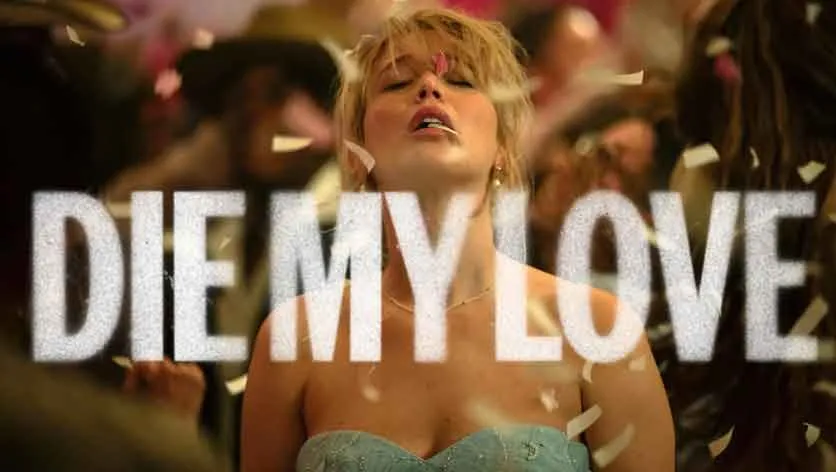
Die My Love Dir: Lynne Ramsay (13th Floor Film Review)
Die My Love delivers a visceral, unflinching portrait of postpartum depression and psychosis, anchored by a career-defining performance from Jennifer Lawrence.
Starring Jennifer Lawrence LaKeith Stanfield, Nick Nolte, and Sissy Spacek.
As Grace, a once-free spirit now trapped in an isolated farmhouse in rural Montana, Lawrence is utterly mesmerising. Every micro-expression, every twitch, every flicker of barely suppressed rage feels lived-in and painfully authentic. You simply cannot look away.
The film’s constant movement back and forth in time is initially disorienting—perhaps even frustrating. Yet, in hindsight, these temporal shifts prove essential. They form the emotional spine of Grace’s story, revealing who she was before motherhood, isolation, and her own mind began closing in. Without that context, the claustrophobic horror of her unravelling—and the profound loss of self that defines it—would not land with the same force.
We see a pre-baby Grace and her partner Jackson move into the farmhouse—once beautiful, now woefully neglected and haunted by the lingering presence of Jackson’s uncle, who fatally shot himself in the butt. Fuelled by young lust and big plans, she will write; he will resurrect the house. Instead, the house becomes Grace’s prison, and what unfolds within its peeling walls is less a great American novel than a great American tragedy.
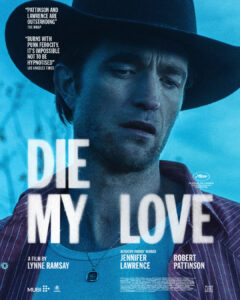
Robert Pattinson is perfectly cast as Jackson, a casually cruel, self-absorbed man-child bewildered by Grace’s escalating distress. His responses veer toward the worst possible choices, not out of malice but out of sheer ineptitude. One of his most consequential missteps comes when he breaks a fundamental rule of partnership by bringing home a dog without discussing it with Grace. The dog—unable to be soothed and constantly barking—becomes an externalisation of Grace’s inner turmoil. It leads to one of the film’s most disturbing scenes (I had to cover my eyes), but it never feels gratuitous. It culminates in the devastating line: “Something you love is suffering. Put it out of its misery.” In that moment, we see the full extent of Grace’s mental purgatory.
Grace is unmistakably the intellectual centre of the couple, which makes watching her brilliant mind spiral into a chaotic internal hellscape even more heartbreaking. The film’s cataclysmic conclusion is almost operatic in its tragedy; Leonard Cohen’s Dance Me to the End of Love floated into my mind unbidden, a fitting accompaniment to this frenzied folie à deux.
Lawrence has never shied away from difficult roles, but this is a bold choice even for her. She owns the narrative completely and never overplays it. Despite the explosive scenes, her most devastating work happens in the quiet moments—the moments where Grace is simply desperate to still feel seen. In the hands of a less grounded actress, Grace could have come across as unsympathetic or even callous. Lawrence instead reveals her humanity: raw, fractured, and deeply familiar to anyone who has feared losing themselves.
At the film’s core is an unmistakably human thread: fear. Fear of loss, of the people we love, and of who we might become. The daily erosion of passion, the disorienting fugue of early motherhood, the creeping terror that one’s partner, talent, and sanity are slipping away—Die My Love captures all of it with startling clarity.
In the verbal combat scenes, Lawrence and Pattinson unleash hell. Not a word is wasted as they circle one another like street fighters, probing for the most vulnerable places to strike with laser-focused precision. Who has the power to hurt you more than the people you love most?
Yet it is in the quieter moments that the magic truly happens. These scenes reveal who Grace was, and still is, beneath the suffocating oppression of domestic mundanity. Her tender relationship with her late father-in-law, Nick Nolte’s Harry—seen in flashback—and with Jackson’s grieving mother Pat, a perfectly restrained Sissy Spacek, shows the kind, complicated heart beneath her spiky exterior.
Die My Love is a career high for Jennifer Lawrence, showing exactly what she is capable of in the right hands. I’m calling it now: expect multiple Best Actress nominations come awards season.
This is the reality of being human, pared back to its raw, ugly, acerbic, wounded, sensitive, tender, enraged truth—and it is nothing short of devastating.
Jo Barry
Die My Love is in cinemas now.