
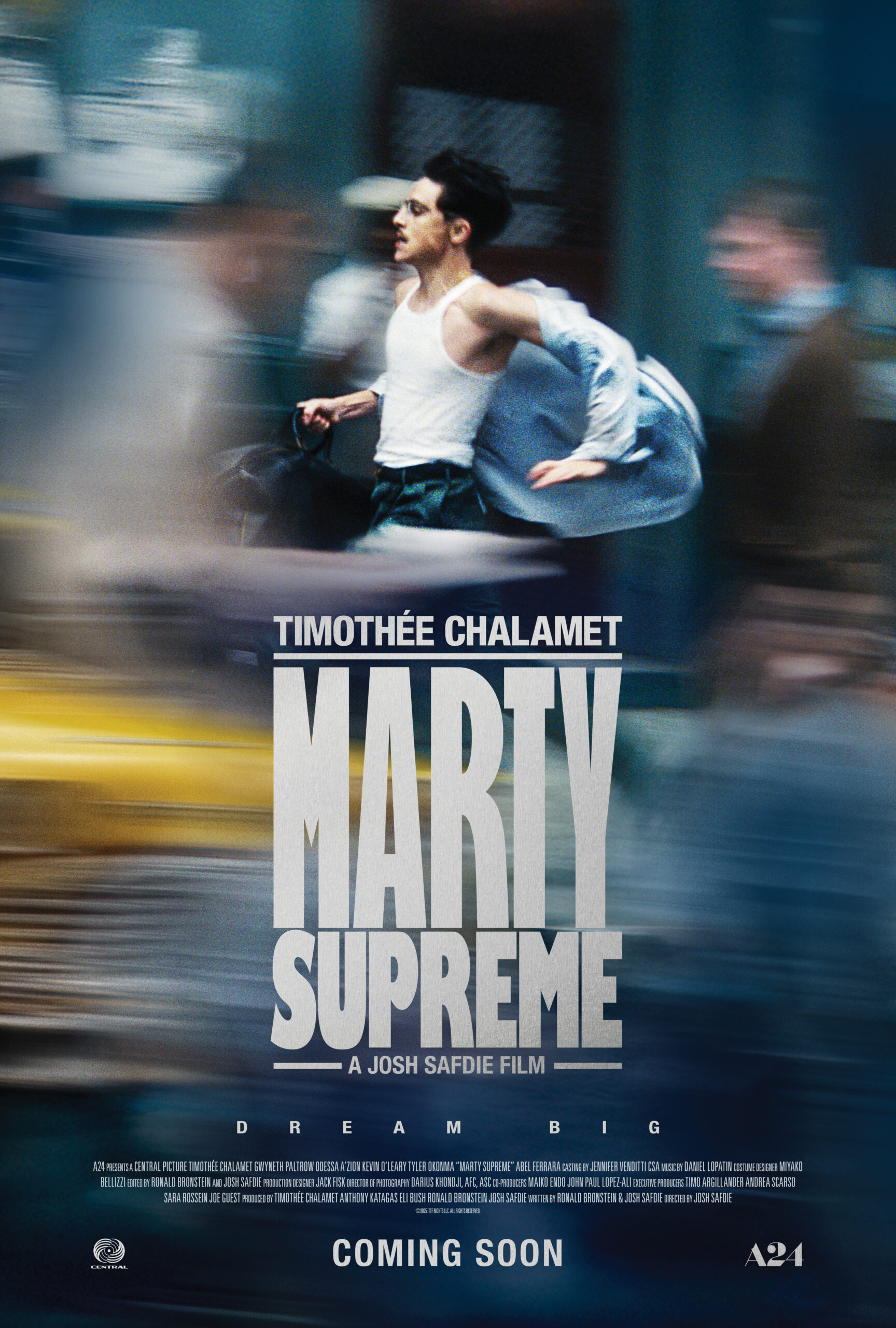
Marty Supreme – Dir: Josh Safdie (13th Floor Film Review)
Timothée Chalamet gives ’em the old paddle-dazzle in Josh Safdie’s frenetic sports biopic Marty Supreme, which somehow manages to keep all of its balls in the air — but only just.
STARRING Timothée Chalamet, Gwyneth Paltrow, Odessa A’zion, Kevin O’Leary, Tyler Okonma, Abel Ferrara, Fran Drescher
Loosely based on Marty Reisman’s 1974 autobiography The Money Player, and taking inspiration from Martin Scorsese’s 1986 classic The Colour of Money — a reference Chalamet himself has cited along with as Robert Rossen’s The Hustler (1961), Marty Supreme is, at heart, a classic tale of an underdog’s desire to better themselves at any cost.

New York, 1952. Marty Mauser, a professional table tennis player, is working in his uncle’s shoe shop and dreaming of winning the British Open in London. His uncle wants to promote him; Marty wants to leave — and he does, taking the money from the store’s safe with him. What follows is a whirlwind of cross and counter-cross as Marty hustles his way from New York to London, back to New York, and on to Japan, culminating in a thrilling showdown with deaf Japanese champion Koto Endo (Koto Kawaguchi).

There is a lot to like about Marty Sup.reme The supporting cast is as solid as it gets. It’s great to see Fran Drescher in a role she can really get her teeth into as Marty’s mother, Rebecca, and Gwyneth Paltrow reminding us that she can act outside of keeping a straight face while telling us that GOOP products are affordable. Her character, Kay Stone — a wealthy retired actress/socialite in an unhappy marriage who is drawn to Marty’s charisma and self-belief — is probably the film’s most sympathetic figure. She knows who she is, understands the transactional nature of the world, and her liaison with Marty is very much on her own terms.
Kevin O’Leary, as Milton Rockwell — Kay’s extremely wealthy and utterly loathsome husband — goes full villain as Marty’s highly conditional backer. Tyler, the Creator brings an engaging film debut to the table as Marty’s best friend and fellow table tennis hustler, Wally, while Odessa A’zion, as Rachel, Marty’s childhood friend and damsel in distress (or is she?), gives a convincing performance that gives a degree of sympathy to the moral questionability of Rachel’s actions.

If there were an award for least screen time, biggest impact (think Anthony Hopkins’ 16 minutes in The Silence of the Lambs), Abel Ferrara as gangster Ezra Mishkin would win it hands down. Either him or… Moses the dog.
Speaking of Moses, I’d like to briefly digress. There is an extended bit involving the dog that I did not love — in fact, I hated it. I have a deep loathing for the use of the “animal in peril” trope to manipulate audience engagement. It’s unnecessary, and the only way it “engages” me is by making me furious, which means the movie then has to work harder to win me over — a strategy that feels distinctly counterproductive. I’ll save you a side trip to the spoiler site Does the Dog Die: he doesn’t. But as a plot device, it’s still not OK.
Which brings us to the main man, and the question of whether young Mr C deserves all the plaudits coming his way. It’s not a cut-and-dried question. A character like Marty Mauser would usually be described as a “charming grifter”, but the thing is, he really shouldn’t be charming at all. He’s a cocky narcissist who leverages everyone around him for his own advancement — steals from family, manipulates friends, and treats loyalty as transactional — and yet, somehow, Chalamet has us rooting for him whenever he picks up a paddle.

That alchemy is helped by the fact that Chalamet trained for months under former American Olympian Wei Wang to convincingly deliver the table tennis scenes — and deliver he does. I never would have thought I’d be describing table tennis as “thrilling”, but thrilling it is. Those sequences are what make all the hustling and arrogance cohere. Mauser is arrogant because he is great at the game, and he is so great at the game — at least in part — because he is arrogant.
So, objectively speaking, and putting aside my deep disappointment that this is most likely not going to be Michael B Jordan’s year to win an Oscar for Sinners, I would have to say that Chalamet deserves all of the accolades being thrown his way.
I can’t close out this review without a shout-out to Darius Khondji’s cinematography, which is nothing short of brilliant. Shot in 35mm, it allows for seamless crossover between capturing every emotion that crosses Chalamet’s face and immersing the audience in the frantic energy of a table tennis match. The camera becomes a character in its own right — unsurprising, given that Khondji was also the cinematographer on Se7en, a film renowned for its atmospheric use of 35mm.
So, did I love Marty Supreme? I did not. Can I stop thinking about it 24 hours later? No, I cannot. Which means its karma has clearly run over my dog-ma in more ways than one, and I have no choice but to recommend that you see it in a cinema — where that glorious cinematography can truly be appreciated, and because, as Stellan Skarsgård so perfectly put it last week, “cinema should be seen in cinemas”.
Jo Barry
‘MARTY SUPREME’ RELEASES IN NEW ZEALAND CINEMAS JANUARY 22