
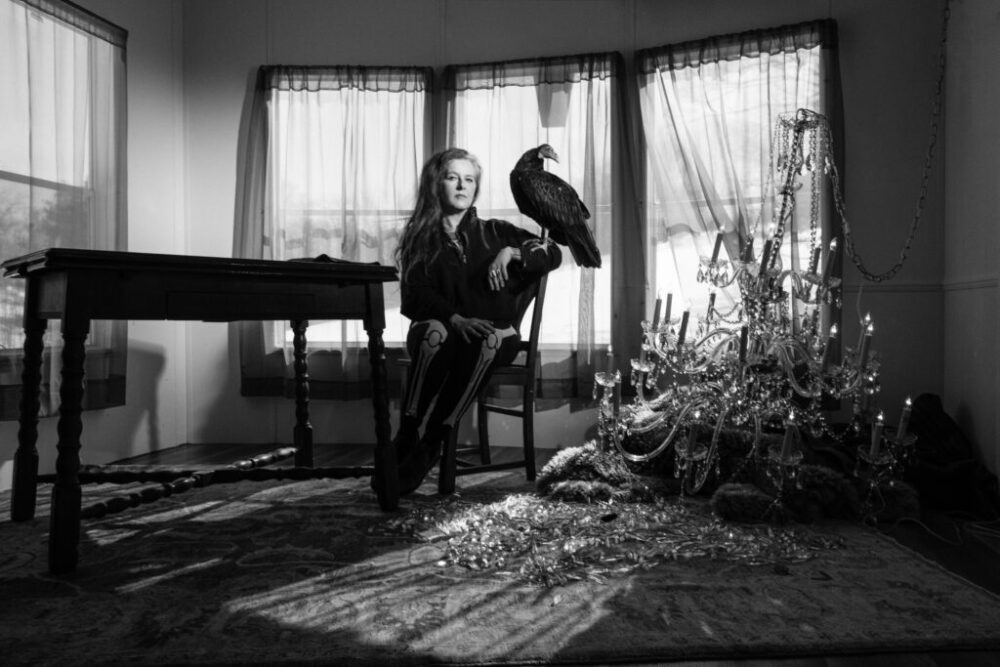
Neko Case – Neon Gravy, Midnight Green and Making Soup: 13th Floor MusicTalk Interview
Neko Case is just about to release Neon Grey, Midnight Green, her first new studio album since 2018.
During that “down” time, Neko wrote her memoir, The Harder I Fight, The More I Love You, and then wrote more songs. The fruits of that labour can be heard all over this new record.
The 13th Floor’s Marty Duda spoke to Neko, who was home in Vermont, and started out by asking the obvious question…
Click here to listen to the interview:
And read a transcription of the interview here:
Marty: So what did motivate you to finally make this record?
NEKO: Well, I mean, I had been planning to make one the whole time and I’d been working on songs the whole time. It’s just, I had to really schedule things in a way that made sense. And the pandemic really was in the way because, you know, a little bit of the record was recorded during the tail end, but there was just so much other stuff going on that, you know, I did it in little chunks.
But it never left my field of vision. It just had to take a little backseat now and again.
Marty: And you produced it yourself this time, which is good fun. And I noticed there’s quite a use of strings throughout it. So tell me what kind of, what were you thinking about when you wanted an overall sound for the record?

NEKO: Well, I produced most, a lot of my records. ⁓ It’s always collaborative. I just decided to credit myself as the main producer since I did it in my own studio. The strings and the orchestra were because I probably got one of the last recording advances anyone’s ever gonna get. And I wanted to make sure that I spread the money out and paid real musicians. Because this would be the last opportunity I had to do that.
And so along with my regular cast of real musicians, ⁓ I wanted to have an orchestra and see what that sounded. I wanted to do something lush. And ⁓ it was really very moving and ⁓ a really incredible experience.
Marty: Yeah, I mean when you hear those like soaring strings right at the beginning on Destination, the opening track, it just kind of grabs you and draws you in, doesn’t it? So what were the sessions like? What did they feel like to you? Were they different than what you’ve done before? Was there anything that’s changed?
NEKO: The regular bed tracks weren’t done with the orchestra. So that was just the band and I, and that was done here at my studio, which was very comfortable and homey and warm. And then I went to Colorado where the orchestra was tracked because a lot of the folks are in the Colorado Symphony. And my friend, Tom Hagerman, who did the orchestration for the songs actually lives in Colorado as well. So, they were recorded out there. And so, I attended those sessions kind of as a guest in a way. But it was really incredible to like, I don’t think I would have been able to perform with them because it was just too overwhelmingly beautiful. I did a lot of crying. There was a shit-ton of crying. Grateful crying.
Marty: That’s nice. That’s the right kind of crying anyway. Have you sung in front of orchestras and things like that in live?
NEKO: No, I’ve never done that. And I think that I would be so overwhelmed that I might just, my mouth would just dry up.
Marty: I’ve gone to a few shows here in Auckland where local artists have played in front of the Philharmonia and whatever. It’s pretty impressive and it’s just great to be at the …
NEKO: I’ve see other people do it. Yeah, it’s so huge. musicians are kind of, people are really trying to phase us out. So I remind people what it sounded like when there were people in a room together playing and the air is not taken out in editing and you hear human breaths and scraping their sleeve on a microphone or a little bit of bleed through the headphones from the drums or something. I just wanted that to be there because it’s not really how people produce records these days and I miss it.
Marty: Are you concerned about AI? Is that kind of what you’re alluding to? Taking the personal thing out of it?

NEKO: Not me. mean, I don’t want my music mimed by AI to make a music that’s not real. I’m not afraid of it. I don’t think AI can write a song that will make you pull your car over and cry.
Marty: But is there something that, because I don’t know exactly how it works either, but is there a way of taking your music out of the equation? Because they seem to have access to everything, right?
NEKO: I mean, I don’t want to put myself in a position to be there. But in the world right now, we don’t have a lot of control and nobody, mostly what I’m concerned about is streaming, which is a magnificent technology and a fucking brilliant invention. ⁓ But unfortunately, the people who have control of it are total shit heels and do evil things and they don’t pay us. So, you know.
Marty: And it trickles down to folks like us as well. So it just ruins the whole music industry.
NEKO: It really does ruin the whole thing. So I’m hoping we all go back to something a little more analog and we just take it back somehow.
Marty: Alrighty, now back to the record, have the title track, Neon Grey Midnight Green, kind of starts out with like a droney kind of, is that a cello or something that’s kicking that off, do you remember?
NEKO: I’m not sure what the first instrument is. It might be an Ebow on guitar. I’m not really sure, but then there’s a lot of baritone guitar all over it.
Marty: And it gets very loud and kind of fuzzy by the end. What can you tell me about how that came together?
NEKO: Well, it was a really great excuse to play tenor guitar or baritone guitar, which is one of my favorite sounds in the world. And we just wanted to be hammer-headed guitar dorks. That’s what we wanted. We just wanted to be like 12 year old boys rocking out. And it was also a nice excuse to try to make some Bulgarian harmony happen.
Marty: Bulgarian harmony?
NEKO: Yeah, close droning harmony.
Marty: Yeah, I get you. And what about the lyrics? And what does the title mean to you anyway? Why did you choose that for the album?
NEKO: When I think about where I am on the map of the world and I close my eyes and I try to locate myself, the first thing I see is the sky and the Pacific Northwest where I’m from. The neon gray is the low ceiling clouds and the midnight green is a color that happens either summer or fall when the twilight is turning to dark and it’s pretty much just indicative of that place. And so they’re very primal markers for me, I think.
Marty: All right. And I think I read somewhere in the assets that I received that Rusty Mountain is kind of the heart of record, that track. Is that true? And if it is, why, from your point of view, why would that be?
NEKO: Um, actually I feel like Destination is more the heart of the record. It’s an ode to many women that I met coming up in music who navigated differently than I did….and they had excellent swagger and the song is followed by Tomboy Gold, which is a song that’s the sister song of Destination, is Destination is my view of the subjects and Tomboy Gold is the view from the perspective of the people I’m singing about.
So it’s kind of inside outside.
Marty: And you’re starting to do some shows, I think, beginning at the beginning of October. What are those going to look and sound like?
NEKO: I have no idea yet. mean, I’ve got a friend, so that’s good. We have some excellent bands coming on tour with us, Des Demonas and John Grant. So I’m really excited about that. I’m excited about good music and camaraderie and seeing everybody’s face. I miss the people.
Marty: So do you think about how you try to recreate what’s on the record when you do it live or is that a whole other thing?
NEKO: Well, that’ll be impossible because I’m not gonna have an orchestra. The cool thing about playing live is that it takes a lot less people to make a big sound than it does on a recording. It’s kind of like how the camera adds 10 pounds, like being live adds 10 pounds already. So it’ll be a little different, but we wanna make sure that the same sonic textures are there so it won’t feel like a puny little version of the song.
Marty: Gotcha. I was hoping to touch on Little Gears for just a little bit. a little bit different than some of the other tracks on the record and sonic wise and is that a baritone sax that’s in there?
NEKO: It’s a baritone clarinet actually. Bass clarinet, yes. There’s not a lot of people in the world who play those.
Marty: Anything else you want to reveal about the song itself? Little Gears.
NEKO: Well, it really is about me watching a spider build a web. and I was blown away by how quickly they do it. It’s like, God, could you be more perfect? I felt a little jealous, frankly. But then I was like, yep, of course you’re awesome. You’re spiders. I love spiders. And it makes me just think, why do people think we’re the greatest thing on earth when there’s so much nature that is just as good, or even more amazing than we are?
Marty: Well that whole attitude of we’re the best and we’re number one, it permeates through humankind no matter where you are. ⁓
NEKO: And it’s really getting us nowhere.
Marty: That’s a fact. It’s getting worse and worse, unfortunately. I don’t know how much you want to go on about the political situation that we find ourselves in these days, but I’m sure you have thoughts about it.
NEKO: There’s a Nazi rapist in the White House. It’s great. That’s going real…that’s going real over here. And I didn’t vote for him. And I don’t think that many people actually did. And to the rest of the world, I am so sorry.
Marty: It’s interesting seeing it from outside because I’m from the States and I remember when I first came here even 30 years ago it was like quite eye-opener to see how the country reflected back.
NEKO: Yeah, I remember the last time I was in New Zealand and there had just been that shooting and watching Jacinda Ardern gracefully handle the whole situation and then have to go home to the clown. And I just felt so cheated, but I usually do by politics anyway, in general.
Marty: But she ended up having to resign and move to the States because she didn’t feel safe here anymore. So there you go. It’s horrible. So like I said, it’s universal. She’s in Harvard, I think.
NEKO: Bye my house. Yeah. Well, she was phenomenal and that’s pretty cool that you guys had her for a while.
Marty: I agree. All right. And I also hoping to touch on the last song on Match-Lit, especially that little Love Is Strange thing that’s happening at the end. I always love Mickey and Sylvia, I named my daughter, Sylvia.
NEKO: You did? That’s so sweet. Yeah, that song ⁓ is for my friend Dallas Good (of The Sadies) who passed away a couple years ago. And he is in a band with a guy named Richard Reid Perry and they were in a band together as well. I didn’t actually meet Richard until after Dallas passed away. And so I worked on his final record with Dallas and then he came in to sing the little love is strange at the end because Dallas loved Mickey and Sylvia. But we also had a huge bond over The Everly Brothers.
Marty: You can’t go wrong there either.
NEKO: And they were the basis of Richard and Dallas’s friendship too. And so we thought it would be really special if we added that on there.
Marty: Have ever listened to the Davis Sisters, Skeeter Davis and her sister? ⁓ yeah. okay, I was wondering. Because they’re kind of the, you talk about the harmonies from The Beatles that were inspired by The Everly Brothers and back, if you go back far enough you kind of end up with them.
NEKO: They’re pretty amazing. And Skeeter Davis was the first person to ever harmonize with herself on a recording. Yeah, I think it was, I Forgot More Than You’ll Ever Know, I think. no, maybe it was, you know what? I haven’t read, I read her biography, which is really good. It’s called, Bus Fare From Kentucky. It’s actually right over there in the bookcase. And she talks about it in there. And it’s like, whoa, that’s so cool, Skeeter Davis.
Marty: I didn’t know that. I think she was married to one of the guys in NRBQ at some point.
NEKO: She was, yes, Joey (Spampinato), think. And yeah, she passed away, I guess, probably 15 years ago now.
Marty: Yeah. Very underrated. But there you go. Probably because she’s female. We talk about that quite a bit here in New Zealand about females and how they’re being treated, especially in the music business. Do you think it’s changing? Is it any different? Is it any better? is it about, is it just the same struggle?
NEKO: Well, there’s more of us now, which is great, but it’s more of us to be treated like shit kind of. So, you know, right now, especially in America, it’s particularly great as you’ve noticed. So we’re just hanging in there, saturated as we are.
Marty: Have you ever considered doing something else?
NEKO: Well, I like making soup a lot. I used to work in a restaurant and making soup was really nice. Felt good to feed people that you weren’t gonna meet. It just felt like, I’m gonna give you one healthy meal of this day. Because I love you, even if I don’t meet you. And so that was always really nice. And I like writing a lot, but I’m not gonna quit music because men are dicks. Plenty of women are dicks too.
Marty: That’s good.
NEKO: The patriarchy will not stop me. mean, there are there was a time when I would have been burned at the stake for wearing trousers. So that’s I keep going, you know.
Marty: Yeah, and since you’ve written your memoir, are you thinking of writing more?
NEKO: Yeah, I really want to write fiction. Because it is really fun because you’re not really talking about yourself, you know, you get to make stuff up. Telling stories is my favorite.
Marty: Is it a similar process for you to writing song and writing fiction, do think?
NEKO: Well they’re a little different, but I mean, I haven’t gotten to really do it as much as I would like fiction. The memoir was different. I think writing fiction is going to feel more like writing songs than a memoir was. Because when it’s about me, I’m like, how boring is this? And luckily I had a really great editor I was working with named Carrie Fry. And I’d be like, Carrie, is this fucking dismal, this is so dull.” And she’d be like, no, it’s fine. And, if I can remember something, she had really great prompts to help me remember something. She was super funny and I just really looked forward to talking to her every week.
Marty:Was it difficult? Was it easy? Was it cathartic to get all your personal stuff out there? Or as much as he cared to put out there?
NEKO: It wasn’t cathartic because I’ve been an over-sharer for a really long time. My friends know all those stories. They’re just stories that I don’t think I would trust anybody but myself to tell. So if I could to finally tell them, ⁓ I don’t know. Putting out a book is really weird because you put out the book and you go on tour for like two weeks and then it’s like nothing ever happened.
It’s not like music where it keeps going and keeps going. It’s just like, and now it’s over. It’s like, well, is there more? Do I have to stuff some envelopes? What do I got? It’s such a different thing. So I feel kind of like I’m just hovering in the air. is there something I’m supposed to be doing right now? But ⁓ I think maybe going on tour for a record is what I’m supposed to do.
Marty: And do you have the book on your merch table?
NEKO: You know what, that’s a good question. don’t know. They’re pretty heavy. We literally have to think really hard about things like what goes on the trailer because they’re legal limits and we have a lot of gear. I don’t know if we’re gonna have books for that reason. We might. Let me just say we might.
Marty: Alright, well that sounds good. Well I think we’ve got to wrap it up because there’s other people waiting to talk to you and hopefully you’ll make it back down to New Zealand sometime. I think it was like 2019 was the last time, wasn’t it?
NEKO: I know it was 2019 and I had the best time and then I came right home into the pandemic and I would really go full circle and come back. So I’m trying.
Neon Grey, Midnight Green is out Friday, Sept. 26 on Anti- Records.
