
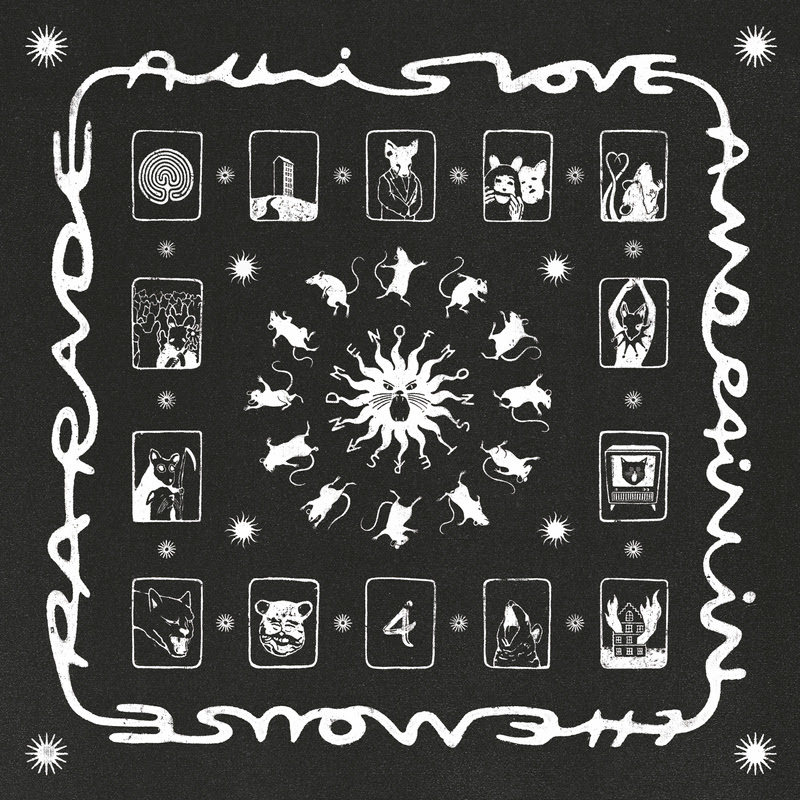
Of Monsters and Men – All Is Love And Pain In The Mouse Parade (Skarkali / Virgin)
Of Monsters and Men’s fourth studio album is ripe with poetic imagery, vulnerable confessions and the complexities of intimacy.
The Icelandic band have fused synthesizers with traditional instruments. This unique effect enhances ritualistic and resonant melodies while surprising with modern rhythms, embellishments and textures.
Television Love begins with soft sparks as trumpet, viola and cello harmonize in an open, expansive sound. Full of tension and expectancy, it suggests the moment before a climax. Rhythmic drums begin with Ragnar þórhallsson’s smooth, grounded voice — the moment before the cliff drop. “I’m bleeding love, all over the place.” The simple refrain is stark and breathtaking. Deep electric guitar and piano chords give the chorus weight. þórhallsson’s voice is soft and melodic as he repeats the devastating phrase, giving power to the lyrics.
Halfway through, there’s a hush. The instruments soften as moments of stillness elongate. Then Nanna Bryndís Hilmarsdóttir begins, higher and more fragile with a melancholic ache in her voice. “Conversation drought, television love…what if we just don’t think at all now?” The drums beat lightly as piano notes are played gently.
The bridge builds into steady resilience, as strings collide with fast-paced drums. The rhythm gives an otherwise melancholic song strength — an undercurrent of life. Television Love ends in a tussock field with wind whipping against wildflowers. Grey clouds are oppressive but not tragic, a quiet strength amidst calamities.
After an intense first track, we are taken to a warmer place in Dream Team. The second track feels like a cheery walk in misty rain. The rhythm is rolling and supported by piano. In the chorus, wind instruments create a luminous atmosphere. The flute opens into a shimmering blossom, evoking a hopeful cascade of feathers. “I don’t want to cry my eyes out, I was hoping for a minute not to care.”
“Worry calls, worry talks. It’s a brain thing, the same thing I try to block. Kicking plants, feeling tall…I don’t want to cry my eyes out.” Dream Team articulates the resistance to suffering and the desire to avoid pain.
The Actor is soft and gentle, with skilful use of glockenspiel, clarinet and saxophone. “I admit, I’m a bit frustrated and I’m tired and I lost the plot.” There’s a sense of loss, cynicism and disillusionment. “With her crooked nose she says, “odds are ever in my favour” Could that be my magnum opus? More like bullshit, my grandiose tumour.” A cutting realism breaks through the airy sound. “I forget I’m masqueradin’, we were laughin’ and then I was not.” The Actor captures fragile selves confronting difficult truths.
Tuna in a Can is memorable and piercing. A soft beginning with strummed guitar, piano and percussion soon elevates intensity. Solid drums pulse with quiet power, contrasting with mournful lyrics. “And it all comes back around. I know that I’ve not really tried.” The drums energise the otherwise solemn piece. Tuna in a Can conveys confusion and ambivalence, both individually and generationally: “I think that I’m the fool that’s insecure. Lost in my mother’s, lost in my daddy’s shoes.”
In Barefoot In Snow, synthesizer, piano, organ and percussion set the scene. The atmosphere calls to mind first shoots after winter — delicate and easily broken. The organ feels veiled and restrained, the first tones of dawn on a cloudy morning. “I never had bright eyes, but had eyes on you. If I could be in the heavenly hue, could you take out the blue?”
Fruit Bat is understated, rich in symbolism and simple in form. Hilmarsdóttir’s voice is ethereal. Slow minor piano accompanies her. “I need something you don’t seem to need, a sweeter goodbye, I’m like a fruit bat hanging’ tight.” A spectral pulse builds through the sorrow as the song develops. þórhallsson’s voice unites with hers in the second half, offering frostbitten hope.
Saxophone, clarinet and trombone create a suspended and sparse atmosphere in the instrumental. The air instruments contrast dramatically against bass piano and rooted drums. “Somehow in the dead of night, we’re like bunny and the reptile.” A forest fairy inhabits this immersive landscape, circling and longing.
Kamikaze startles with intensity. Piano, drums and guitar resonate with precision. “Why do words not always come so easily?…Kamikaze, while the conversations grow your grinding teeth. And you never know just what to say.” The piece explores uncertainty, anxiety and imperfection in relationships, ultimately triumphant in love.
“I was on a train, heading through the veins of your heart. You were lookin’ in, but the passenger window was dark.” Ordinary Creature breathes like radiant air with tucked-away shadows. Airy electric guitar serves as the spine, while fast-paced drums give earthy strength. “I’ve been strolling the beaches, like an ordinary creature.” The chorus balances hope and shelter.
Styrofoam Cathedral is lyrical and introspective. “There I go into my Styrofoam cathedral. Away from the sirens and the grocery stores. Busy parkin’ lots and teeming floors.” The song captures the desire to retreat into one’s interior world. Cello simmers alongside piano, building hypnotic loops. The instrumental is precise, layered, adding fortitude. “I guess I like the pain more than I like my health. Why do I always fly when I don’t have wings?”
Mouse Parade is the most minimal and delicate piece. Piano and layered voices create a sacred echo, with string instruments supporting a weightless atmosphere. Ghostly vocals shimmer like the first snowfall. The piece feels spiritual and timeless.
The End completes the album in a grounding finale. Soft acoustic guitar accompanies a duet between þórhallsson and Hilmarsdóttir. Translucent harmonies evoke emerging seedlings and presence. “I guess it’s kinda funny how the world revolves around a dyin’ sun…Come on darlin’, why’s your mind so far from me now? Come on back to me somehow.” The track is frail yet rich, folding delicate harmonies with depth.
Lexi Tuenter
All is Love and Pain in the Mouse Parade out now via Skarkali / Virgin Music Group
