
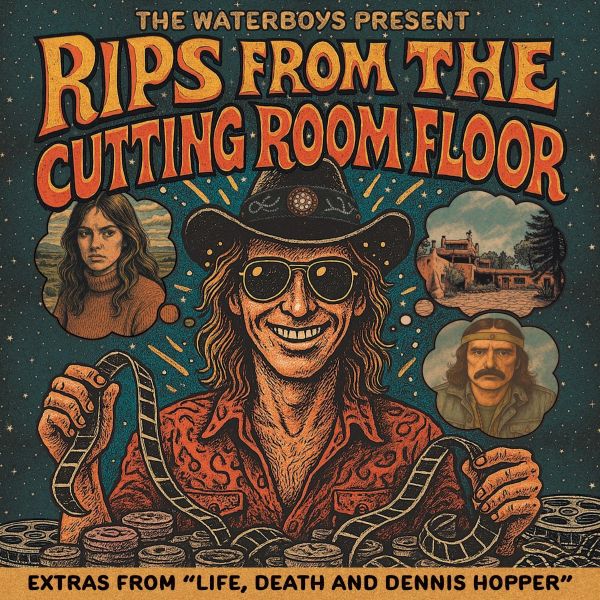
The Waterboys Present: Rips From the Cutting Room Floor (Sun) (13th Floor Album Review)
With Rips From the Cutting Room Floor, The Waterboys push their long-gestating Dennis Hopper project into its widest frame yet.
What began as a single song grew into an EP, then into the double album Life, Death and Dennis Hopper, and now into its own universe complete with a short film and this album of sixteen companion pieces.
Mike Scott’s fascination with Hopper’s voice, humour, contradictions and shifting identities has become the engine of an expansive portrait. The accompanying film, A Wild and Beautiful Ride, available on YouTube, captures the project’s tone: music, spoken word and mood shaping an impressionistic view of an American icon. Rips From the Cutting Room Floor stands beside the earlier album as a parallel work that offers a different point of entry to the same world.

The band animating this world plays with complementary versatility. Scott sets the tone on guitar and vocals, Brother Paul Brown colours the scenes with keyboards, Famous James Hallawell threads in strings and piano, Eamon Ferris grounds the action with sharp drumming, and Aongus Ralston underlines it all with a confident bass pulse. Together they treat each track as a film scene, shifting tone and texture to match Hopper’s blend of memory, myth and invention.
The album opens with Western Roll Call, a cascade of frontier names delivered over hooves, rattles and rising synths. Some figures are real, such as Billy Clanton and Doc Holliday; others blur folklore and invention. It immediately situates the listener in Hopper’s mythic America, shaped as much by movies and tall tales as by lived experience.
From there the record unfolds in vivid scenes. The Next Time I Saw Elvis is an early highlight, a loose shuffle of bass, drums and glowing keys as Hopper recounts two encounters with Elvis, one outside a soda store and one in a hotel corridor. Scott delivers the tale with amused wonder and just enough surreal edge. The filmed performance featuring Dylan Bishop on lead guitar is essential viewing.
Several tracks are more atmospheric than narrative. Cinema, C’est La Vie races forward in bright brass and 1960s colour, like a dance number from a film that never existed but should have. Crystal Morning, New Mexico slows the pulse, horns rising over steady drums and a drifting guitar line. On the Set of the Last Movie adds a contemplative instrumental moment, its quiet tension evoking half-built sets and fading spotlights. Alejandro Jodorowsky’s Arrival in Taos rumbles with synths and drums in a hazy, hallucinatory swirl, a pointed nod to the surrealist filmmaker.
Energy returns in the tightly wound Funk Out at the Mud Palace, where guitars and drums rattle against each other like a train gathering speed. Cowboy Bill, Guy Grand and Texas keeps the momentum with stabbing guitars and spoken fragments that jump between scenes, echoing Hopper’s impulsive, fast-shifting nature.
The emotional weight arrives in Still Raging On, an early draft of Ten Years Gone. A simple guitar figure underpins Scott’s weary vocal as the phrase “ten years gone, still raging on” recurs. Flipside of the American Dream follows the same reflective thread, a jazzy shuffle with soft keys and a closing female voice that shifts the perspective and softens the edge.
The final sequence forms a suite of miniature character studies. Thank You Mr Schneider offers quiet gratitude to Hopper’s Hollywood mentor shaded by strings and low vocals. The Counterculture Holdout swings on synths, presenting Hopper as the last man standing from a vanishing era, “rolling in a league of his own.” Stanley in I Love the Movies recalls childhood wonder watching Errol Flynn in Dodge City to performing on film sets himself. Dennis in Ameridreams plays as a finance-selling advert that lands with half sincerity and half satire. A Few Words About Dennis Hopper offers a spoken tribute that skips the famous films to celebrate the photographer who captured Ike and Tina, Martin Luther King in Selma and Andy Warhol holding a flower.
The closer, Golf, They Say, is whimsical, affectionate and gently philosophical. Over soft drums and guitar, the refrain that golf is “a beautiful way to get to know your friends” becomes a tender final wave goodbye.
Rips From the Cutting Room Floor may lack the tighter arc of Life, Death and Dennis Hopper, but it widens the frame in purposeful ways, gathering the ideas, side stories and rhythmic detours that couldn’t sit comfortably on the main record.
It offers a parallel perspective on the same world, showing Hopper as both rebel and romantic, insider and outsider, living comfortably behind and in front of the lens. Taken together, the two albums form a portrait that broadens and deepens our understanding of Dennis Hopper and showcases the ongoing inventive force powering Mike Scott.
John Bradbury
Rips From the Cutting Room Floor is out now on Sun Records