
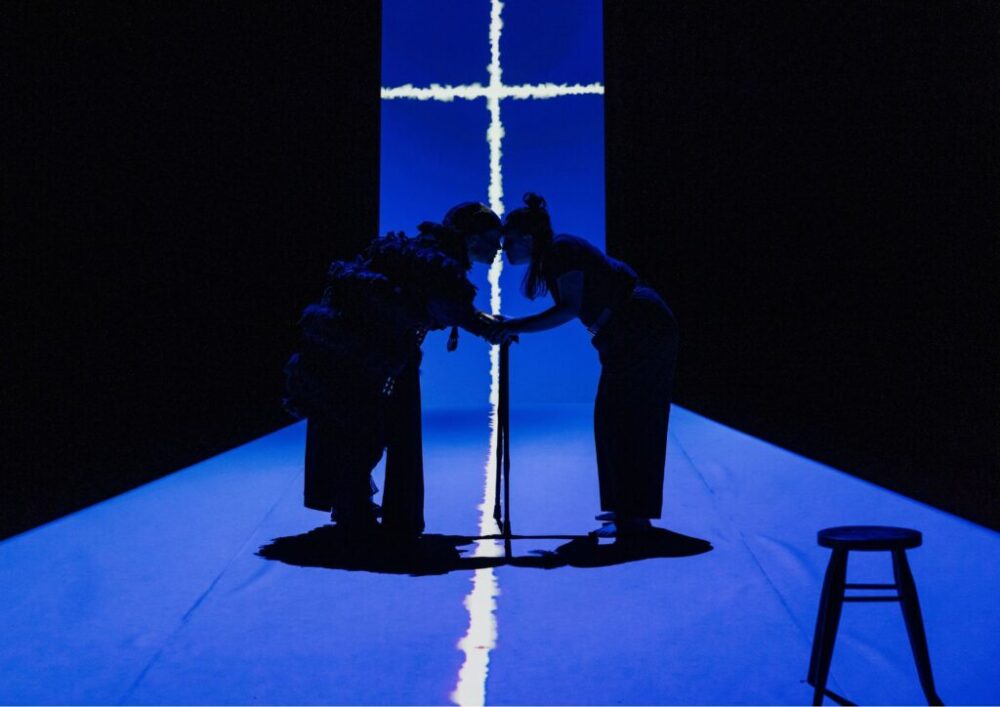
Tiri: Te Araroa, Woman Far Walking by Witi Ihimaera & Auckland Theatre Company, at ASB Waterfront Theatre
Tiri: Te Araroa Woman Far Walking gives us a 185-year-old woman born on the day the Treaty of Waitangi was signed.
Witness to many key historic events—including the slaughters at Matawhero and Ngatapa, the 1918 flu epidemic, the Land March and the 1981 Springbok tour—playwright Witi Ihimaera describes her as the personification of the Treaty of Waitangi.
To what does she attribute her longevity? Sex, she tells us. Sex every day. And the passion, clearly, to pass on her story. One that is woven into our own history.
A bold idea, Ihimaera wields the wero (traditional challenge) as a literary weapon. This is theatre as confrontation—a welcome change from the Waterfront Theatre’s 2025 season of too-many entertainments.
The stage before us is bare, within an abstract forest, the sloping floor and rear screen lit like a doorway to the cosmos. Slowly, a silhouette emerges and becomes material. It’s like the Māori creation story, sound eerily presaging something to come. A figure is gradually revealed, moving haltingly towards us. This we realise, is Tiri. Wearied with age, bent with her years, seeming somehow to cast a shadow of the palisades of defensive war.
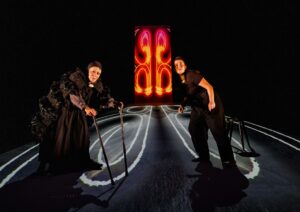
It’s a moving start, brilliantly delivered with masterful theatrical craft. Bringing to bear all the weapons of the theatre: abstract set (John Verryt) which bears similarity to Wieland Wagner’s simple abstractions, inviting imagination to take flight; direction. lighting and vision design (Katie Wolfe, Jane Hakaraia & Owen McCarthy respectively); and the very sound of creation itself (Kingsley Spargo.). And of course, there’s Tiri herself, played by the much-acclaimed Miriama McDowell (last seen on this stage playing Friar Lawrence here with real mana),
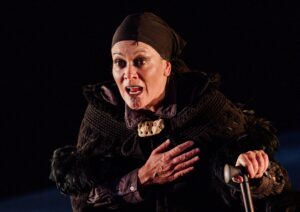
McDowell has a tough role to play here—it’s a two-hander (she’s on-stage the whole time) in which her character is the story. And we have to love her. And fear her. Even with all the theatrical craft in the world, this stands or falls on her performance. It stands. It stands mightily.
Tiri of course is short for Te Tiriti o Waitangi Mahana. One thing about which she is never short however is an opinion. Or a lament. Or a tall tale or three, freighted with humour sometimes, but with a punchline that still might tear your heart out.
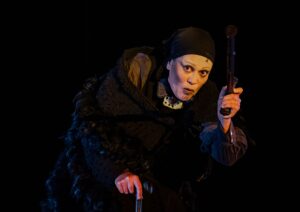
Some of her tales are too tall for her ‘avatar,’ Tilly played by Nī Dekkers-Reihana (The Haka Party Incident, The Mooncake & the Kumara, May Mga Uad Ang Utak Mo) who delights in correcting her while dramatising the stories. She is flawless, a Puckish figure, shapeshifting to be mother one minute, daughter the next, even future husband serenading the widow, and then warriors making a brave last stand. And utterly convincing in all, from waiata to haka to taua.
The play was first performed twenty-five years ago, and has been updated for this new age with Katie Wolfe (The Haka Party Incident, Hē Māngai Wāhine, Kawa) and Te Pou Theatre’s Maioha Allen. “Updated” literally, of course, since our protagonist is twenty-five years older, and all the wiser and more acerbic for that.
Updated too to confront the politics and greater language facility of today: One of the particular shifts in Māori storytelling identified by Wolfe is abandoning the earlier idea that we’ll “be taken into a lovely Māori worl …, the cheeky nannies and magical tamariki, a misty eyed look to the past.” A sort of local minstrelsy. “That’s no longer good enough,” she says. “When Witi wrote Woman Far Walking, it was a furious play, brimming with rage and violence, and then a very generous amount of hope. In our present political climate, we are leaning into these qualities, the rage, the violence, the hope, and we do that with an unprecedented confidence to perform in both languages of this nation.”
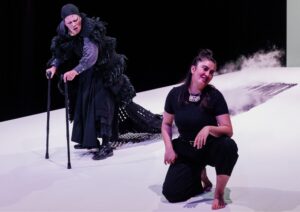
Sliding easily between English and te reo, this may be the only easy partnership on display. The challenge is direct. Literally. Actors speak directly to audience members. It’s confrontational. As it should be. It invites audience participation—and will, I’m sure, receive it.
The use of te reo is engaging, and necessary. The production itself fairly reeks with symbolism, and needs to.
But here’s the weakness, one shared with many of Ihimaera’s works. Of lyricism there is much, but of plot there is too little. The theatrical craft is brilliant, and must be. Because the story here is simply episodic, not plot-driven, so there’s too little to drive it forward beyond simple curiosity: specifically, which stories will be told? And the dates and events that are plucked out are surprising, most obviously because Tiri bewails the loss of land, yet there is no raupatu in her tales.
Tiri and avatar are woven together brilliantly however, and we could have watched their interplay all night.
But like the Wandering Jew, Kundry, or the Flying Dutchman, fated to walk the earth for all time, we must ask: Will Tiri ever find peace? Will we? Should we?
Ake, ake, ake!
Theatre Peter
Woman Far Walking runs at the ASB Waterfront Theatre from November 4 – 23.
More info here
Tickets here.
Interview here.
